8. Instruction and Learning Environment
1. create a school culture for learning;
2. envision and enable instructional and auxiliary programs for the improvement of teaching and learning;
3. recognize the developmental needs of elementary, secondary and middle level students in order to design positive learning experiences;
4. accommodate differences in cognition and achievement;
5. mobilize the participation of appropriate people to develop programs and to establish a positive learning environment.
Creating a positive learning environment is an essential part of educating all students. It begins with a vision and mission for the school that will ultimately benefit the students. Then action goals to support the mission need to be established and integrated into the school by means of a school improvement plan (SCIP) which should be a living document. This means that the staff members all need to be part of creating, and willing to buy into the mission and goals, to be prepared to revisit the goals often and assess how well they are each meeting their obligation when it comes to the goals.
Part of the plan needs to be how the school accommodates the needs of different learners. Standards-based education means that some students will need additional time and possibly support to meet the standards. A plan to provide this additional support needs to be just as strategically designed as the plan to provide the initial instruction. This requires accurate assessment of students and sharing of that information with appropriate parties: support teachers, summer school staff, etc. Formative assessment is the key to accommodation within the classroom, but interim assessment is vital in accommodations that take place in after school programs or support classes. Interim assessment looks specifically at the benchmarks taught within a unit or quarter to see which students have mastered them. Students who have gaps in their learning should receive targeted intervention in those specific areas. This is always one goal for after school programs, but with specific benchmarks tested on a periodic basis, it is much easier to manage and share information regarding which students need more targeted instruction.
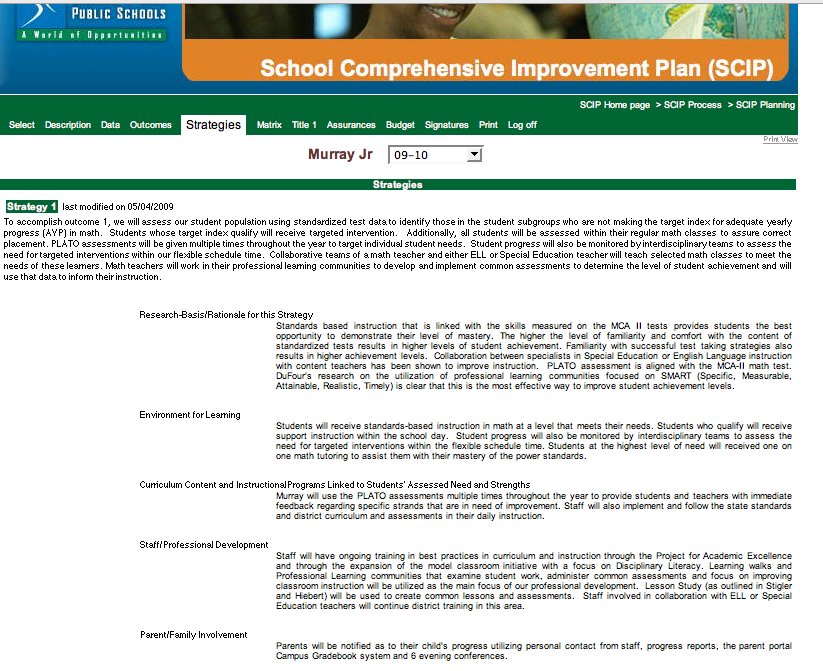
Part of the plan that my Leadership Team developed for next year is a system for month-long mini-classes within the school day to have mandatory interventions – failure will truly not be an option. We were initially uncertain how we were going to assess which students needed support in what area, aside from homework help, then I learned about interim testing. It is an easy fit for our building, as we already use a testing system called PLATO several times per year for our kids, but have only used the data as summative, never to group students for re-teaching. We used it last year to assess our teaching, but it is an excellent tool for interim testing, as it can tell us there students fall in meeting specific benchmarks. This type of test can also be used as a pre-test to see which students will need up-front support on foundational concepts needed before beginning instruction in upcoming units.
The concept of having required interventions within the school day is an idea that I will carry with me. There are a multitude of benefits to this concept. First, if it is during the school day, it can truly be required; after school programs are not effective if the parents need the students to be home to take care of younger siblings or other purposes. Second, students will be taught by teachers from the school and same department, but not necessarily the same teacher as they have for the regular class; often a different style makes a difference in learning. Third, the students only need to be part of the support class for as long as there is a demonstrated need. Students who do poorly on summative assessments such as the MCA are referred to the after school program for an entire year, potentially never getting the targeted help they need. Fourth, and this one is a bit optimistic, if it is possible to meet all student needs within the school day, we would not need after school programs for academic support or, ultimately, summer school programs for credit recovery, saving the district money.
1. create a school culture for learning;
2. envision and enable instructional and auxiliary programs for the improvement of teaching and learning;
3. recognize the developmental needs of elementary, secondary and middle level students in order to design positive learning experiences;
4. accommodate differences in cognition and achievement;
5. mobilize the participation of appropriate people to develop programs and to establish a positive learning environment.
Creating a positive learning environment is an essential part of educating all students. It begins with a vision and mission for the school that will ultimately benefit the students. Then action goals to support the mission need to be established and integrated into the school by means of a school improvement plan (SCIP) which should be a living document. This means that the staff members all need to be part of creating, and willing to buy into the mission and goals, to be prepared to revisit the goals often and assess how well they are each meeting their obligation when it comes to the goals.
Part of the plan needs to be how the school accommodates the needs of different learners. Standards-based education means that some students will need additional time and possibly support to meet the standards. A plan to provide this additional support needs to be just as strategically designed as the plan to provide the initial instruction. This requires accurate assessment of students and sharing of that information with appropriate parties: support teachers, summer school staff, etc. Formative assessment is the key to accommodation within the classroom, but interim assessment is vital in accommodations that take place in after school programs or support classes. Interim assessment looks specifically at the benchmarks taught within a unit or quarter to see which students have mastered them. Students who have gaps in their learning should receive targeted intervention in those specific areas. This is always one goal for after school programs, but with specific benchmarks tested on a periodic basis, it is much easier to manage and share information regarding which students need more targeted instruction.
Part of the plan that my Leadership Team developed for next year is a system for month-long mini-classes within the school day to have mandatory interventions – failure will truly not be an option. We were initially uncertain how we were going to assess which students needed support in what area, aside from homework help, then I learned about interim testing. It is an easy fit for our building, as we already use a testing system called PLATO several times per year for our kids, but have only used the data as summative, never to group students for re-teaching. We used it last year to assess our teaching, but it is an excellent tool for interim testing, as it can tell us there students fall in meeting specific benchmarks. This type of test can also be used as a pre-test to see which students will need up-front support on foundational concepts needed before beginning instruction in upcoming units.
The concept of having required interventions within the school day is an idea that I will carry with me. There are a multitude of benefits to this concept. First, if it is during the school day, it can truly be required; after school programs are not effective if the parents need the students to be home to take care of younger siblings or other purposes. Second, students will be taught by teachers from the school and same department, but not necessarily the same teacher as they have for the regular class; often a different style makes a difference in learning. Third, the students only need to be part of the support class for as long as there is a demonstrated need. Students who do poorly on summative assessments such as the MCA are referred to the after school program for an entire year, potentially never getting the targeted help they need. Fourth, and this one is a bit optimistic, if it is possible to meet all student needs within the school day, we would not need after school programs for academic support or, ultimately, summer school programs for credit recovery, saving the district money.

|
Pilot time one-month matirx.doc Size : 0.04 Kb Type : doc |

|
SCIP Strategies.png Size : 0.168 Kb Type : png |