12. Measurement and Evaluation
1. determine what diagnostic information is needed about students, staff, and the school environment;
2. examine the extent to which outcomes meet defined standards, goals or priorities;
3. draw inferences for program revisions;
4. interpret measurements for evaluations;
5. relate programs to outcomes;
6. develop equivalent measurements of competence and design accountability mechanisms.
Measurement can take many forms and each piece of data is important and needs to be looked at in its own way for specific purposes. As leaders, we are held to the results of the No Child Left Behind tests to see if the results have met the Annual Yearly Progress goals. Wise leaders will also “keep their finger on the pulse” of progress the students are making during the school year. A school needs systems for collecting and examining data throughout the year to see whether students are moving toward meeting the mission goals and if they are on track with meeting the standards in each area of the curriculum. Doing this requires very organized systems and clear direction on the part of the leader. Specific, quantitative data needs to be available to view and discuss to assess student progress.
I have, over the years as part of writing School Improvement Plan (SCIP) goals and examined state summative data. As a teacher, I have always used formative assessment, both formal and informal. However, while leading the science department’s Professional Learning Community (PLC) last year, I had the opportunity to look at data another way. At the time, I was unaware that it was a separate class of assessment data – Interim Data. This is data, from common assessments given across a number of classrooms, is examined to see whether the essential benchmarks that were the goal of that unit were actually being met. This testing can inform instruction as far as the need for re-teaching and can identify certain staff members who seem to have a knack for teaching specific benchmarks. The latter is useful for PLCs and/or Lesson Study; the group discusses the specific strategies used by teachers whose students are very successful in meeting specific benchmarks and the whole group observes these strategies during a classroom visit, then writes a common set of lessons to teach the concept.
In the future, I will facilitate staff development that supports teachers in the use of the powerful tools of formative and interim assessment. Generally, as an administrator, I will need to rely on summative data, such as the MCA tests to see if my staff and programs are on track. I prefer, however, to be more proactive and encourage the use of interim data to see where we are missing the mark as we go through the process. This way, systems can be put into place and safety nets created to give students targeted instruction, where needed to ultimately meet the learning goals. This is an area where working closely with my district’s assessment and data group to get help set up appropriate interim testing so we can see which learners would benefit from additional support and then supplying it in a timely manner.
1. determine what diagnostic information is needed about students, staff, and the school environment;
2. examine the extent to which outcomes meet defined standards, goals or priorities;
3. draw inferences for program revisions;
4. interpret measurements for evaluations;
5. relate programs to outcomes;
6. develop equivalent measurements of competence and design accountability mechanisms.
Measurement can take many forms and each piece of data is important and needs to be looked at in its own way for specific purposes. As leaders, we are held to the results of the No Child Left Behind tests to see if the results have met the Annual Yearly Progress goals. Wise leaders will also “keep their finger on the pulse” of progress the students are making during the school year. A school needs systems for collecting and examining data throughout the year to see whether students are moving toward meeting the mission goals and if they are on track with meeting the standards in each area of the curriculum. Doing this requires very organized systems and clear direction on the part of the leader. Specific, quantitative data needs to be available to view and discuss to assess student progress.
I have, over the years as part of writing School Improvement Plan (SCIP) goals and examined state summative data. As a teacher, I have always used formative assessment, both formal and informal. However, while leading the science department’s Professional Learning Community (PLC) last year, I had the opportunity to look at data another way. At the time, I was unaware that it was a separate class of assessment data – Interim Data. This is data, from common assessments given across a number of classrooms, is examined to see whether the essential benchmarks that were the goal of that unit were actually being met. This testing can inform instruction as far as the need for re-teaching and can identify certain staff members who seem to have a knack for teaching specific benchmarks. The latter is useful for PLCs and/or Lesson Study; the group discusses the specific strategies used by teachers whose students are very successful in meeting specific benchmarks and the whole group observes these strategies during a classroom visit, then writes a common set of lessons to teach the concept.
In the future, I will facilitate staff development that supports teachers in the use of the powerful tools of formative and interim assessment. Generally, as an administrator, I will need to rely on summative data, such as the MCA tests to see if my staff and programs are on track. I prefer, however, to be more proactive and encourage the use of interim data to see where we are missing the mark as we go through the process. This way, systems can be put into place and safety nets created to give students targeted instruction, where needed to ultimately meet the learning goals. This is an area where working closely with my district’s assessment and data group to get help set up appropriate interim testing so we can see which learners would benefit from additional support and then supplying it in a timely manner.

|
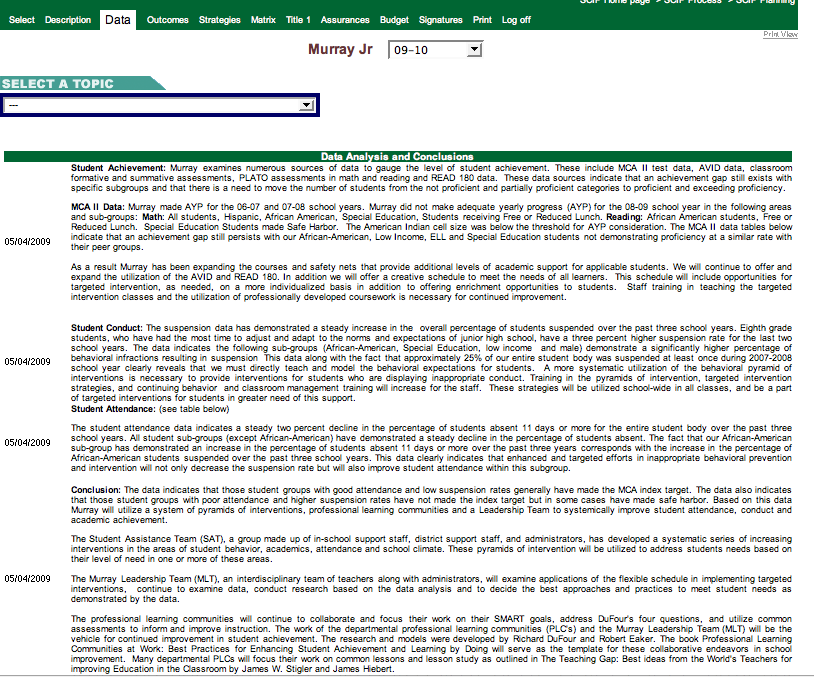
SCIP Data Page 3.png Size : 0.047 Kb Type : png |
|
|
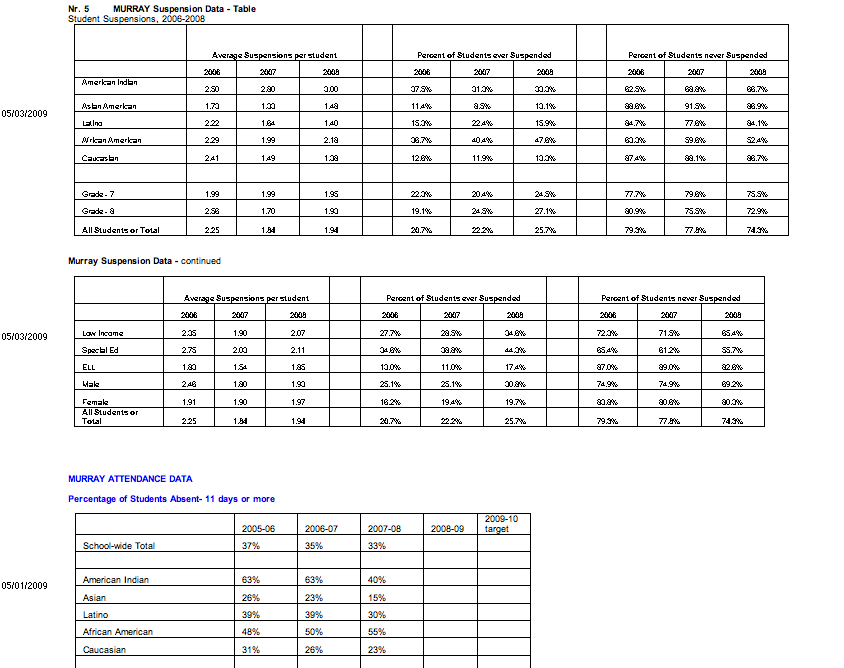
SCIP Data page 1.png Size : 0.141 Kb Type : png |

|
PDPLC student MCA survey.xls Size : 0.05 Kb Type : xls |
|
|
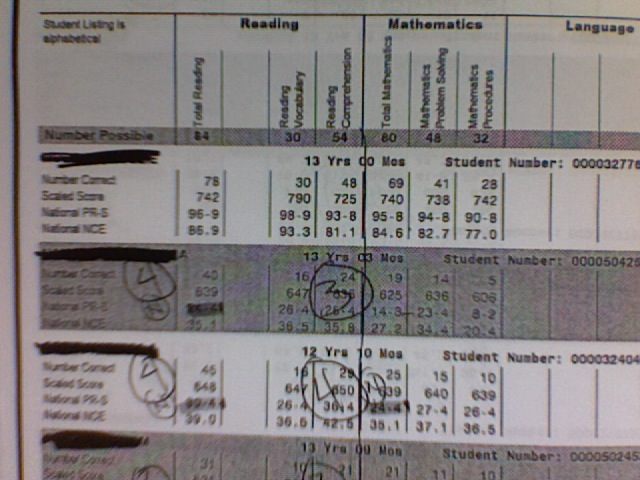
SAT 10 results for support classes.jpg Size : 0.098 Kb Type : jpg |