20. Policy and Political Influences
1. understand schools as political systems;
2. identify relationships between public policy and education;
3. recognize policy issues;
4. examine and affect policies individually and through professional and public groups;
5. relate policy initiatives to the welfare of students and families;
6. address ethical issues.
Schools have become more and more political institutions. It has, to some extent, always been so, but in the current climate of funding issues, declining enrollment, and school choice, it is more important now than ever before to be savvy when it comes to viewing a school as part of a political system. It is also wise to have in-depth understanding of policies and how they impact students and families. In a larger sense, when viewed through the lens of how important a public education is to a free democracy, administrators have a moral imperative to understand politics and policies that affect their buildings.
One current policy that all public schools need to deal with currently is the No Child Left Behind legislation (NCLB) and Annual Yearly Progress (AYP) tests and use to grade schools. This year, my school’s Leadership Team began planning for next year with an alternative schedule to meet the needs of many more students with specific, targeted assistance in a mandated attendance format (as opposed to after school or summer school programs). In addition, we will be implementing a district-mandated program for college readiness and instituting staff development within the school day. With policy changes come growing pains as buildings attempt to build capacity to meet ever-changing expectations. While many complain about the requirements of NCLB, the spirit behind the legislation is a noble one: education for all, not for the majority, but everyone. If wholesale changes within a school building bring about meeting the needs of every student, it is worth the struggle to implement these changes.
As a leader with my own building, I see this as an area where I will tap into the expertise of knowledgeable others within the district for support, as well as relying on input from staff and the community. By accessing district support and following district course in general, I will not only gain the knowledge of others and resources from the district, but also build political capital for my building within the district.
1. understand schools as political systems;
2. identify relationships between public policy and education;
3. recognize policy issues;
4. examine and affect policies individually and through professional and public groups;
5. relate policy initiatives to the welfare of students and families;
6. address ethical issues.
Schools have become more and more political institutions. It has, to some extent, always been so, but in the current climate of funding issues, declining enrollment, and school choice, it is more important now than ever before to be savvy when it comes to viewing a school as part of a political system. It is also wise to have in-depth understanding of policies and how they impact students and families. In a larger sense, when viewed through the lens of how important a public education is to a free democracy, administrators have a moral imperative to understand politics and policies that affect their buildings.
One current policy that all public schools need to deal with currently is the No Child Left Behind legislation (NCLB) and Annual Yearly Progress (AYP) tests and use to grade schools. This year, my school’s Leadership Team began planning for next year with an alternative schedule to meet the needs of many more students with specific, targeted assistance in a mandated attendance format (as opposed to after school or summer school programs). In addition, we will be implementing a district-mandated program for college readiness and instituting staff development within the school day. With policy changes come growing pains as buildings attempt to build capacity to meet ever-changing expectations. While many complain about the requirements of NCLB, the spirit behind the legislation is a noble one: education for all, not for the majority, but everyone. If wholesale changes within a school building bring about meeting the needs of every student, it is worth the struggle to implement these changes.
As a leader with my own building, I see this as an area where I will tap into the expertise of knowledgeable others within the district for support, as well as relying on input from staff and the community. By accessing district support and following district course in general, I will not only gain the knowledge of others and resources from the district, but also build political capital for my building within the district.

|
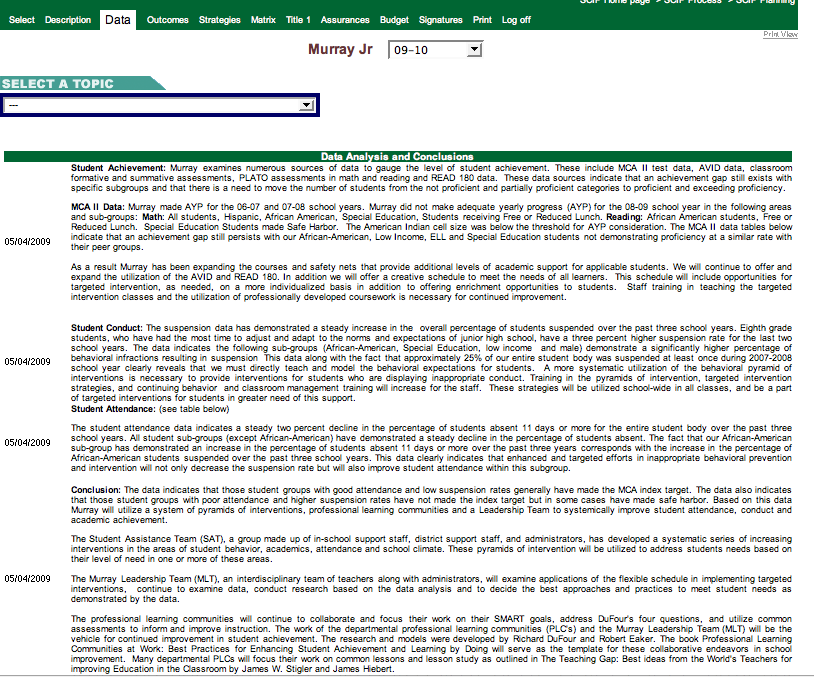
SCIP Data page 1.png Size : 0.141 Kb Type : png |

|
Sample PLC-PDP minutes.doc Size : 0.02 Kb Type : doc |