5. Organizational Oversight
1. plan and schedule work so that resources are used appropriately and goals are met;
2. schedule the flow of activities;
3. establish procedures to regulate activities;
4. monitor projects to meet deadlines.
Given the fact that schools rarely have funds to spare, it is very important for an administrator to make the most of the resources – human or other – available. The master schedule needs to meet the needs of the students, but also support the staff. For example, in a secondary environment, teacher prep hours should be planned so that courses are available during as many periods as possible, but it is also wise to attempt to schedule common preps for new teachers and mentors. Providing time for new teachers to meet with mentors eliminates one open section time, but will ultimately benefit the students by supporting the new teacher. Schedules are also important when implementing programs. In schools with interdisciplinary teams, scheduling a common team prep time for all teachers is a vital part of supporting the learners. The schedule should also provide for flexibility – occasional changes to accommodate assemblies or more permanent changes, (such as the adding or losing of a staff member for enrollment purposes) should not cause the overall schedule to crumble.
During the time that I was preparing for my administrative license, and to some extent even before, I was involved in scheduling. At my former school, which was a K-8, I was responsible for creating the junior high schedule. Things I needed to keep in mind were class length, allowing for team-teaching with ELL staff during reading time, the prep schedule of the rest of the building, regulations regarding the length of time mandated between breakfast and lunch, schedules that would break the students into different groups for elective and reading classes (students attended “core” classes with their homeroom group) for variety. I also used test data to enroll students in graduation test-prep classes during strategic times – students who had been on the cusp of passing the grad rule math test the previous year was registered for the test-prep class during the quarter before the test was given during the current year.
At my current school I have been involved in planning the science department schedule with one of our AP’s. Given the frequent use of lab equipment involved in science and the fact that we attempt to follow the same sequence within courses, equipment is shared between at least two teachers during most days. This year, I developed a schedule that allowed for at least one section of each class during nearly every hour, spread the prep hours out, grouped class sections so teachers would teach periods of one subject, then switch to the other for the remainder of the day -- usually with a prep in between, and placed our half-time teacher into a time where her classes better supported the master schedule. Everyone agreed that the schedule was workable. Then one of the teachers learned that she would not be eligible for a waiver to teach one of her courses (she had been using waivers for three years), and would need to switch to teaching within her license area. I met with the AP and, having suspected that this would be the case, and pointed out that I built the schedule so that we could switch section blocks to meet licensing requirements without impacting the rest of the science department or master schedule. Unfortunately, this meant that our half-time teacher would need to switch what she taught; she had been looking forward to teaching the same thing two years in a row, but was willing to make the change.
Looking forward to next year, our Leadership Team is planning a half-period called Pilot Time, which will meet many needs within the building but could also cause scheduling issues. It will be a time that students in band and language can meet their PE and Health requirement, other students can get targeted support in classes, students may have the option of taking enrichment courses, teachers will be able to use the time twice per month for PLC work, and we have negotiated a way to use the time to meet the new district mandated college readiness course for junior high. The new schedule took a while to gain support, but we were able to sell the benefits both for the students and teachers to the extent that there is now momentum for the program.
For the future, I hope to maintain my enjoyment for creating schedules. I need to be mindful that as the scope of the schedule gets larger, the importance of meeting the needs of students along with creating good political will among staff make the process both more complex and rewarding. The schedule should meet the needs of the learners, be adaptable for late start/early release days or assemblies, rotate “choice” prep hours at least yearly, maximize the use of part-time staff, follow applicable regulations, and be able to absorb permanent changes as needed. I will get input from departments and/or teams for suggestions and, to the extent that it makes sense, implement the suggestions. But ultimately, the wants of the staff do not override the needs of the learners.
1. plan and schedule work so that resources are used appropriately and goals are met;
2. schedule the flow of activities;
3. establish procedures to regulate activities;
4. monitor projects to meet deadlines.
Given the fact that schools rarely have funds to spare, it is very important for an administrator to make the most of the resources – human or other – available. The master schedule needs to meet the needs of the students, but also support the staff. For example, in a secondary environment, teacher prep hours should be planned so that courses are available during as many periods as possible, but it is also wise to attempt to schedule common preps for new teachers and mentors. Providing time for new teachers to meet with mentors eliminates one open section time, but will ultimately benefit the students by supporting the new teacher. Schedules are also important when implementing programs. In schools with interdisciplinary teams, scheduling a common team prep time for all teachers is a vital part of supporting the learners. The schedule should also provide for flexibility – occasional changes to accommodate assemblies or more permanent changes, (such as the adding or losing of a staff member for enrollment purposes) should not cause the overall schedule to crumble.
During the time that I was preparing for my administrative license, and to some extent even before, I was involved in scheduling. At my former school, which was a K-8, I was responsible for creating the junior high schedule. Things I needed to keep in mind were class length, allowing for team-teaching with ELL staff during reading time, the prep schedule of the rest of the building, regulations regarding the length of time mandated between breakfast and lunch, schedules that would break the students into different groups for elective and reading classes (students attended “core” classes with their homeroom group) for variety. I also used test data to enroll students in graduation test-prep classes during strategic times – students who had been on the cusp of passing the grad rule math test the previous year was registered for the test-prep class during the quarter before the test was given during the current year.
At my current school I have been involved in planning the science department schedule with one of our AP’s. Given the frequent use of lab equipment involved in science and the fact that we attempt to follow the same sequence within courses, equipment is shared between at least two teachers during most days. This year, I developed a schedule that allowed for at least one section of each class during nearly every hour, spread the prep hours out, grouped class sections so teachers would teach periods of one subject, then switch to the other for the remainder of the day -- usually with a prep in between, and placed our half-time teacher into a time where her classes better supported the master schedule. Everyone agreed that the schedule was workable. Then one of the teachers learned that she would not be eligible for a waiver to teach one of her courses (she had been using waivers for three years), and would need to switch to teaching within her license area. I met with the AP and, having suspected that this would be the case, and pointed out that I built the schedule so that we could switch section blocks to meet licensing requirements without impacting the rest of the science department or master schedule. Unfortunately, this meant that our half-time teacher would need to switch what she taught; she had been looking forward to teaching the same thing two years in a row, but was willing to make the change.
Looking forward to next year, our Leadership Team is planning a half-period called Pilot Time, which will meet many needs within the building but could also cause scheduling issues. It will be a time that students in band and language can meet their PE and Health requirement, other students can get targeted support in classes, students may have the option of taking enrichment courses, teachers will be able to use the time twice per month for PLC work, and we have negotiated a way to use the time to meet the new district mandated college readiness course for junior high. The new schedule took a while to gain support, but we were able to sell the benefits both for the students and teachers to the extent that there is now momentum for the program.
For the future, I hope to maintain my enjoyment for creating schedules. I need to be mindful that as the scope of the schedule gets larger, the importance of meeting the needs of students along with creating good political will among staff make the process both more complex and rewarding. The schedule should meet the needs of the learners, be adaptable for late start/early release days or assemblies, rotate “choice” prep hours at least yearly, maximize the use of part-time staff, follow applicable regulations, and be able to absorb permanent changes as needed. I will get input from departments and/or teams for suggestions and, to the extent that it makes sense, implement the suggestions. But ultimately, the wants of the staff do not override the needs of the learners.

|
Pilot time one-month matirx.doc Size : 0.04 Kb Type : doc |

|
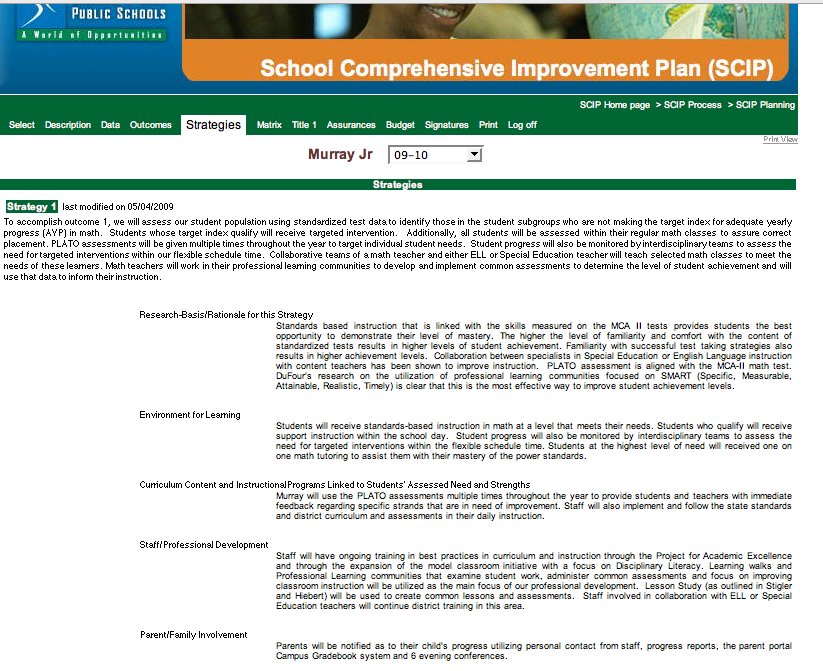
SCIP Strategies.png Size : 0.168 Kb Type : png |