1. Leadership
1. provide purpose and direction for individuals and groups;
2. shape school culture and values;
3. facilitate the development of a shared vision for the school;
4. formulate goals and plan change efforts with staff by setting priorities in the context of community and district priorities and student and staff needs.
The most important factor in leadership is leading without micro managing -- not directly taking on all responsibilities, but not losing touch with what is happening within the building. The leader shapes the direction and systems within a building, using the vision and mission along with smaller goals along the way, incorporating input from other stakeholders. The leader needs to understand the personality of the school along with where it stands in relation to where it should be. Leaders need to have good relationships with, and find positive ways to guide staff, parents, and community members to understand priorities and build a committed team with which to move forward.
During the past couple of years at Murray I have had the chance to work on both the mission, along with the supporting “collective commitment” steps that will help the mission take shape; and our school’s continuous improvement plan (SCIP). The mission/collective commitment process was a far more arduous task, as it is an area where the school has the most freedom to shape its own goals and was formed with input from the entire staff along with parents and community members. The process involved a volunteer facilitator, the school’s site council (of which I am a member) and whole staff at meetings. It took over a year to complete, from the beginning stages of brainstorming ideas, to creating a mission that was short enough to identify with, but still included all elements that everyone wanted, to selecting a core group of supporting statements that we all agree will move us toward our mission. Finally, this year we “approved” the mission and collective commitments by voting – everyone giving a vote of at least a “3” on a five-point scale, we moved forward. There not yet been discussion as to examining how we are doing on our progress toward meeting achieving the mission.
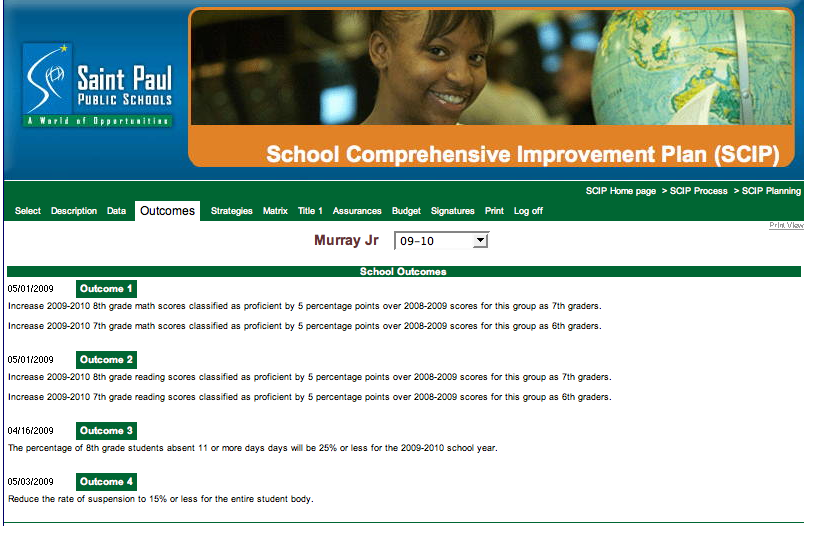
The SCIP process was a different matter. The parameters were very specific as to what our goals needed to be – no more than five goals, two of which needed to address reading and math. The school had freedom to select the remaining goals according to individual building needs. However, the goals needed to be within specific topics/parameters that matched the district’s goal areas. Examining the school data while writing the SCIP was an enlightening experience. While the initial goals that I proposed needed to be adapted to fit the ultimate district goals, the opportunity to focus the goals to fewer than we had the previous year, and make them more specifically to match our school’s personality was very educational. It was also a great experience to find research to support our plans for the coming school year.
What I have learned through this process to move forward is that it all starts with a vision and mission. My own mission, for whatever level I work with is: Learners prepared for their next step without remediation. From this point, I will work with my staff to create a shared vision and mission for the school – one which is embraced and carried out by the staff, rather than only agreed to. From that point, action items need to be developed to help the school meet the mission. The SCIP and budget are joined with a building culture to support and pay for the steps needed to achieve the mission. One important step in the process of leading a staff toward the mission is, as Collins wrote, getting the right people on the bus and in the right seats, meaning that a critical component any organization is hiring people who are motivated to move forward. But also when you have a group of people, whether you have hired or inherited them, selecting staff leaders who will support the direction for the school and be able to lead smaller groups through the process. These people need to be motivated, organized, and charismatic when it comes to bringing the rest of the staff on-board.
Effective leadership involves setting the vision, guiding the process of selecting a mission, selecting leaders, creating systems, giving support, and allowing the process to move forward. From that point, monitoring and celebrating are key. Throughout the entire process (and indeed in all parts of a leader’s career), the leader needs to keep open lines of communication – to be able to hear and accept successes, struggles, and ideas for the future.
Collins, Jim. Good to Great. 2001 HarperCollins New York, NY.
1. provide purpose and direction for individuals and groups;
2. shape school culture and values;
3. facilitate the development of a shared vision for the school;
4. formulate goals and plan change efforts with staff by setting priorities in the context of community and district priorities and student and staff needs.
The most important factor in leadership is leading without micro managing -- not directly taking on all responsibilities, but not losing touch with what is happening within the building. The leader shapes the direction and systems within a building, using the vision and mission along with smaller goals along the way, incorporating input from other stakeholders. The leader needs to understand the personality of the school along with where it stands in relation to where it should be. Leaders need to have good relationships with, and find positive ways to guide staff, parents, and community members to understand priorities and build a committed team with which to move forward.
During the past couple of years at Murray I have had the chance to work on both the mission, along with the supporting “collective commitment” steps that will help the mission take shape; and our school’s continuous improvement plan (SCIP). The mission/collective commitment process was a far more arduous task, as it is an area where the school has the most freedom to shape its own goals and was formed with input from the entire staff along with parents and community members. The process involved a volunteer facilitator, the school’s site council (of which I am a member) and whole staff at meetings. It took over a year to complete, from the beginning stages of brainstorming ideas, to creating a mission that was short enough to identify with, but still included all elements that everyone wanted, to selecting a core group of supporting statements that we all agree will move us toward our mission. Finally, this year we “approved” the mission and collective commitments by voting – everyone giving a vote of at least a “3” on a five-point scale, we moved forward. There not yet been discussion as to examining how we are doing on our progress toward meeting achieving the mission.
The SCIP process was a different matter. The parameters were very specific as to what our goals needed to be – no more than five goals, two of which needed to address reading and math. The school had freedom to select the remaining goals according to individual building needs. However, the goals needed to be within specific topics/parameters that matched the district’s goal areas. Examining the school data while writing the SCIP was an enlightening experience. While the initial goals that I proposed needed to be adapted to fit the ultimate district goals, the opportunity to focus the goals to fewer than we had the previous year, and make them more specifically to match our school’s personality was very educational. It was also a great experience to find research to support our plans for the coming school year.
What I have learned through this process to move forward is that it all starts with a vision and mission. My own mission, for whatever level I work with is: Learners prepared for their next step without remediation. From this point, I will work with my staff to create a shared vision and mission for the school – one which is embraced and carried out by the staff, rather than only agreed to. From that point, action items need to be developed to help the school meet the mission. The SCIP and budget are joined with a building culture to support and pay for the steps needed to achieve the mission. One important step in the process of leading a staff toward the mission is, as Collins wrote, getting the right people on the bus and in the right seats, meaning that a critical component any organization is hiring people who are motivated to move forward. But also when you have a group of people, whether you have hired or inherited them, selecting staff leaders who will support the direction for the school and be able to lead smaller groups through the process. These people need to be motivated, organized, and charismatic when it comes to bringing the rest of the staff on-board.
Effective leadership involves setting the vision, guiding the process of selecting a mission, selecting leaders, creating systems, giving support, and allowing the process to move forward. From that point, monitoring and celebrating are key. Throughout the entire process (and indeed in all parts of a leader’s career), the leader needs to keep open lines of communication – to be able to hear and accept successes, struggles, and ideas for the future.
Collins, Jim. Good to Great. 2001 HarperCollins New York, NY.

|
goals.png Size : 0.228 Kb Type : png |