15. Sensitivity
1. understand the concerns of others;
2. deal tactfully with others;
3. work with others in stressful situations or in conflict;
4. manage conflict and obtain feedback;
5. recognize multicultural differences;
6. advocate for family and child issues and work with families to develop parent involvement in the education of children.
Leaders will need to be open if they want to know what their staff is doing, thinking, wanting. That also brings a down side: being on the receiving end of a lot of information dealing with professional, personal, and interpersonal issues. It is important to use judgment to discern which things need immediate attention and which are non-issues. When dealing with factors that need to change, choosing the appropriate type of action is important. When assisting staff in improving their skills, often using a coaching/questioning approach assists the teacher in reflecting on their practices and seeing where they don’t match with the direction that the school is moving. If this technique is ineffective, a more direct approach may be necessary, but always keeping the best interest of the students and school at the center of the conversation.
Coaching with the focus of school mission and best interest of the students is a great way to deal with interpersonal issues as well. If both parties can agree that student needs are truly of primary importance, other problems often seem trivial. In these situations, it is often best to deal with each person separately to find out the background and their proposed solutions so that if guidance and mediation are necessary, there is common ground that the leader can bring up as a starting point.
When dealing with student issues, it is important to get input from all parties involved. Then, when the picture is complete, take appropriate action, making sure to protect the privacy rights of everyone. Documentation is key in this area, as if the conflict results in disciplinary action careful records are necessary to assign appropriate consequences.
At one of my placements, the office received a call from a parent stating that her son was being bullied. The principal asked me to look into the situation. I phoned the mother who informed me that another student had been showing her son inappropriate photos that he had taped in his folder and had also ripped her son’s shirt. When I interviewed the son, he said that the photos story was accurate, but that the other student had a new folder and didn’t sit at his table anymore. He further told me that he was not the target of the bullying, and that the other student was not the bully. He had witnessed another student, a “friend,” being picked on by a group of boys. When I interviewed the “friend” he told me that he was not ever picked on and felt very safe in the building and grounds (he also added that he barely knew the original boy). I discussed the events with the principal and we agreed that the bullying report sounded like a non-issue (I suspect this was not the first go-around with this family). I spoke with the teacher regarding the inappropriate photos, let her know that the student had a new folder, but asked her to keep an eye out. I then phoned the mother to thank her for reporting the incident and let her know that her son reported feeling safe during our interview and to let her know that we were employing strategies to keep these issues from coming up again. She wanted more specifics about what actions the school was going to take, I let her know that I couldn’t discuss specifics, but that we were working on several strategies.
From this single incident, I learned that while follow through, information collection, and communication are very important, it is sometimes the reaffirmation that people want. I believe that the student did have inappropriate photos, which he got rid of for his own reasons, but that the original reporting student had probably ripped his shirt on his own. Letting the teacher know that there was a potential problem with the student with photos put in place a safeguard against that particular thing happening again, and the original student felt safer knowing that he was listened to. I need to force myself to refrain from my impulse of returning phone messages right away; I need to take time to take stock, reflect on the incident, the people involved, any history, etc. Then, if appropriate, get information from staff that may have insight. Then take the step of calling the parent.
Dealing with staff issues is only slightly different. Sometimes, immediate action is not the best avenue, as things can resolve themselves. However, if I see problems with teaching, I think it is vital to address it quickly – preferably the same day to make the reflective practice more applicable. Guiding teachers in their own reflection by asking the teachers what the point of a lesson was, then finding out how they felt they did and why (guiding their answers if needed) is far more powerful than a top-down review. I will keep the education of our students as the focus of the school’s purpose. It is not the responsibility of the learners to meet the needs of the school for them to get an education; it is our moral duty to meet them where they are in order to meet their needs in the interest of their education.
1. understand the concerns of others;
2. deal tactfully with others;
3. work with others in stressful situations or in conflict;
4. manage conflict and obtain feedback;
5. recognize multicultural differences;
6. advocate for family and child issues and work with families to develop parent involvement in the education of children.
Leaders will need to be open if they want to know what their staff is doing, thinking, wanting. That also brings a down side: being on the receiving end of a lot of information dealing with professional, personal, and interpersonal issues. It is important to use judgment to discern which things need immediate attention and which are non-issues. When dealing with factors that need to change, choosing the appropriate type of action is important. When assisting staff in improving their skills, often using a coaching/questioning approach assists the teacher in reflecting on their practices and seeing where they don’t match with the direction that the school is moving. If this technique is ineffective, a more direct approach may be necessary, but always keeping the best interest of the students and school at the center of the conversation.
Coaching with the focus of school mission and best interest of the students is a great way to deal with interpersonal issues as well. If both parties can agree that student needs are truly of primary importance, other problems often seem trivial. In these situations, it is often best to deal with each person separately to find out the background and their proposed solutions so that if guidance and mediation are necessary, there is common ground that the leader can bring up as a starting point.
When dealing with student issues, it is important to get input from all parties involved. Then, when the picture is complete, take appropriate action, making sure to protect the privacy rights of everyone. Documentation is key in this area, as if the conflict results in disciplinary action careful records are necessary to assign appropriate consequences.
At one of my placements, the office received a call from a parent stating that her son was being bullied. The principal asked me to look into the situation. I phoned the mother who informed me that another student had been showing her son inappropriate photos that he had taped in his folder and had also ripped her son’s shirt. When I interviewed the son, he said that the photos story was accurate, but that the other student had a new folder and didn’t sit at his table anymore. He further told me that he was not the target of the bullying, and that the other student was not the bully. He had witnessed another student, a “friend,” being picked on by a group of boys. When I interviewed the “friend” he told me that he was not ever picked on and felt very safe in the building and grounds (he also added that he barely knew the original boy). I discussed the events with the principal and we agreed that the bullying report sounded like a non-issue (I suspect this was not the first go-around with this family). I spoke with the teacher regarding the inappropriate photos, let her know that the student had a new folder, but asked her to keep an eye out. I then phoned the mother to thank her for reporting the incident and let her know that her son reported feeling safe during our interview and to let her know that we were employing strategies to keep these issues from coming up again. She wanted more specifics about what actions the school was going to take, I let her know that I couldn’t discuss specifics, but that we were working on several strategies.
From this single incident, I learned that while follow through, information collection, and communication are very important, it is sometimes the reaffirmation that people want. I believe that the student did have inappropriate photos, which he got rid of for his own reasons, but that the original reporting student had probably ripped his shirt on his own. Letting the teacher know that there was a potential problem with the student with photos put in place a safeguard against that particular thing happening again, and the original student felt safer knowing that he was listened to. I need to force myself to refrain from my impulse of returning phone messages right away; I need to take time to take stock, reflect on the incident, the people involved, any history, etc. Then, if appropriate, get information from staff that may have insight. Then take the step of calling the parent.
Dealing with staff issues is only slightly different. Sometimes, immediate action is not the best avenue, as things can resolve themselves. However, if I see problems with teaching, I think it is vital to address it quickly – preferably the same day to make the reflective practice more applicable. Guiding teachers in their own reflection by asking the teachers what the point of a lesson was, then finding out how they felt they did and why (guiding their answers if needed) is far more powerful than a top-down review. I will keep the education of our students as the focus of the school’s purpose. It is not the responsibility of the learners to meet the needs of the school for them to get an education; it is our moral duty to meet them where they are in order to meet their needs in the interest of their education.

|
Re Lizzie M. addition to ALC 8th grade.txt Size : 0.001 Kb Type : txt |

|
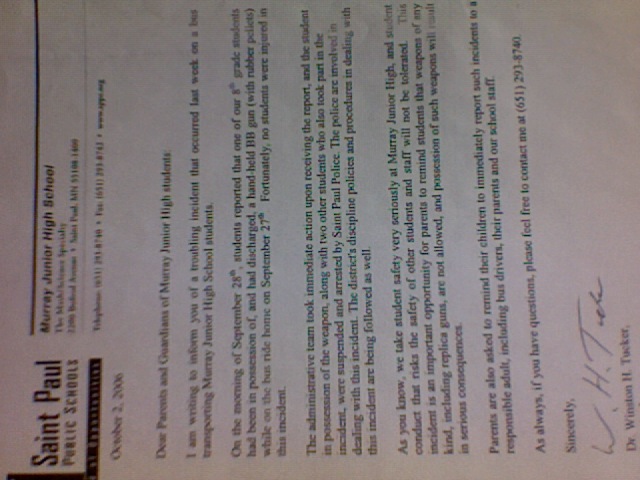
BB Gun Letter.jpg Size : 0.087 Kb Type : jpg |

|
Scheduling issue letters Size : 0.036 Kb Type : unknown |