18. Philosophical and Cultural Values
1. act with an understanding of the role of education in a democratic society in accordance with accepted ethical standards;
2. recognize philosophical influences in education;
3. reflect an understanding of American culture including current social and economic issues related to education.
Public education is an important component, possibly the most important, of supporting a free democracy. A well-educated public is able to compete on a global scale. It is important for educational leaders to remember that to ensure a well-educated public, education needs to be brought to each learner where she or he is. The recent movement to standards-based education and criterion-based assessments is a powerful force that will keep our schools moving forward and maintain the place of the United States in the world stage.
While No Child Left Behind legislation has problems, its essence and spirit are what is needed to keep the United States on the right path when we plan our educational programs. Having a standards based curriculum supports the notion that we need to be mindful of what we need our students to know, purposeful in how we assess whether students know what they need to know, and planful of what we will do when not all students demonstrate understanding. It has forced us to look in the mirror that is data about our practice and make some hard decisions about what needs to change.
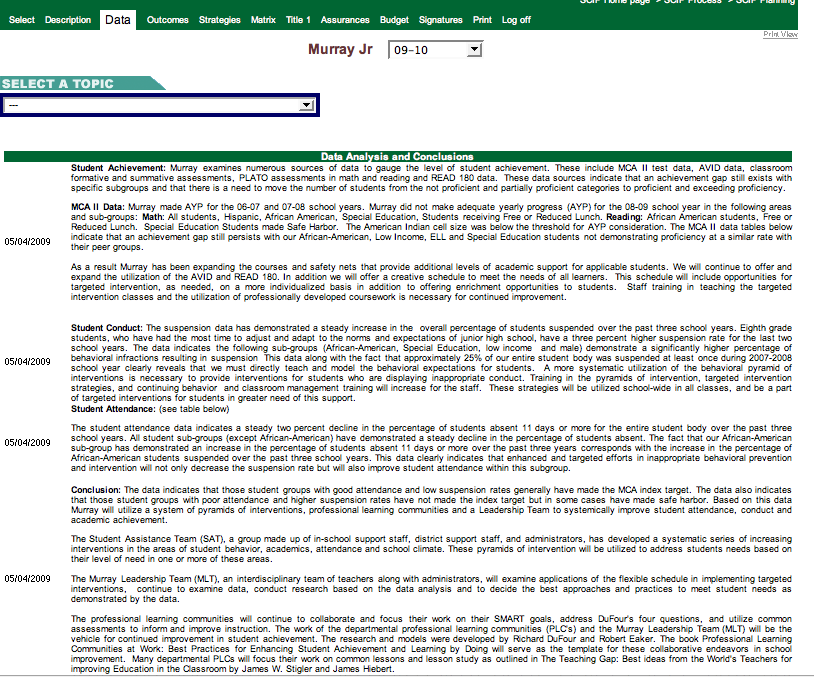
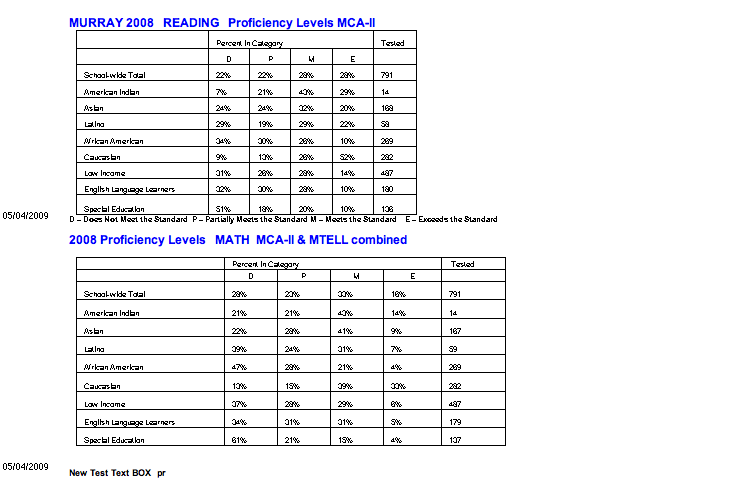
During my experiences during my administrator program, I have had several opportunities to look at education through this lens. I facilitated a Professional Learning Community (PLC) that looked at implementing standards-based curricula based on data analysis at the formative and interim level. The goal of this PLC was to have every student ultimately be proficient on the state’s science assessment. When the test results were in, there was an expected gap between ethnic groups, and an unexpected gender gap. We were able to use this data to further examine our practices to hopefully reduce these gaps in the future – the work in this area continues. There is a strong correlation between students who were proficient on these assessments and students enrolled in our challenge level courses. There is also a strong correlation between gender and race and enrollment in our challenge level courses. As a member of our school’s Leadership Team, this is an area of concern across the school. One of the Leadership Team plans is to de-track our school, creating challenging courses for all learners in an effort to close these gaps.
As I look at running a building, I can’t help but to think that data is the best lens through which to examine this competency. Not only because it is data that we use to inform instruction and how we are judged based on NCLB, but also because it is a standardized way to see if we are meeting the needs of each learner. Schools have a moral obligation to educate all students and when it comes to making tough decisions or having difficult conversations about progress toward meeting that obligation, data is an irrefutable source of information to begin and guide those decisions and conversations. Cultural needs of students need to be met, appreciated, and utilized in creating an effective curriculum and atmosphere within the school. It is imperative to be vigilant in doing so, as ultimately, we are shaping the future of our country.
1. act with an understanding of the role of education in a democratic society in accordance with accepted ethical standards;
2. recognize philosophical influences in education;
3. reflect an understanding of American culture including current social and economic issues related to education.
Public education is an important component, possibly the most important, of supporting a free democracy. A well-educated public is able to compete on a global scale. It is important for educational leaders to remember that to ensure a well-educated public, education needs to be brought to each learner where she or he is. The recent movement to standards-based education and criterion-based assessments is a powerful force that will keep our schools moving forward and maintain the place of the United States in the world stage.
While No Child Left Behind legislation has problems, its essence and spirit are what is needed to keep the United States on the right path when we plan our educational programs. Having a standards based curriculum supports the notion that we need to be mindful of what we need our students to know, purposeful in how we assess whether students know what they need to know, and planful of what we will do when not all students demonstrate understanding. It has forced us to look in the mirror that is data about our practice and make some hard decisions about what needs to change.
During my experiences during my administrator program, I have had several opportunities to look at education through this lens. I facilitated a Professional Learning Community (PLC) that looked at implementing standards-based curricula based on data analysis at the formative and interim level. The goal of this PLC was to have every student ultimately be proficient on the state’s science assessment. When the test results were in, there was an expected gap between ethnic groups, and an unexpected gender gap. We were able to use this data to further examine our practices to hopefully reduce these gaps in the future – the work in this area continues. There is a strong correlation between students who were proficient on these assessments and students enrolled in our challenge level courses. There is also a strong correlation between gender and race and enrollment in our challenge level courses. As a member of our school’s Leadership Team, this is an area of concern across the school. One of the Leadership Team plans is to de-track our school, creating challenging courses for all learners in an effort to close these gaps.
As I look at running a building, I can’t help but to think that data is the best lens through which to examine this competency. Not only because it is data that we use to inform instruction and how we are judged based on NCLB, but also because it is a standardized way to see if we are meeting the needs of each learner. Schools have a moral obligation to educate all students and when it comes to making tough decisions or having difficult conversations about progress toward meeting that obligation, data is an irrefutable source of information to begin and guide those decisions and conversations. Cultural needs of students need to be met, appreciated, and utilized in creating an effective curriculum and atmosphere within the school. It is imperative to be vigilant in doing so, as ultimately, we are shaping the future of our country.

|
SCIP Data page 1.png Size : 0.141 Kb Type : png |
|
|
SCIP Data page 2.png Size : 0.028 Kb Type : png |
|
|
Cinco de Mayo Follow-up Letter.png Size : 0.124 Kb Type : png |