11. Staff Development
1. work with faculty and staff to identify professional needs and to plan, organize and facilitate programs that improve faculty and staff effectiveness that are consistent with institutional goals and needs;
2. supervise individuals and groups;
3. provide feedback on staff performance and arrange for remedial assistance;
4. engage faculty and others to plan and participate in recruitment and development activities;
5. initiate self-development;
6. ensure the provision of training for all general education, special education, and interagency staff, including administrative, professional, paraprofessional, and support staff, on skills for collaboration, teaming, consulting, and conflict resolution.
Schools need to have the capacity to innovate internally and incorporate new models into their programs. The educational leader needs to create an environment of continual improvement based on reflection of practice and data (both quantitative and qualitative). Additionally, individual teachers need to be supported and guided as they improve their own practices. Schools with teachers that keep learning within their craft are more able to meet the needs of all students. It is important that the leader set staff development as a priority and incorporate it specifically within the School Improvement Plan (SCIP).
Over the past years, I have been involved with staff development in several areas. I have facilitated Professional Learning Communities (PLCs), guiding groups of teachers in selecting goals, carrying out the process of learning about our practice based on examining student work, and then reflecting on the PLC system itself, with an eye for the future. I have also been involved in a district initiative where teachers voluntarily participate in staff development for teaming within classrooms; a content teacher with either an ELL or Special Education teacher. This training was both a top-down district implemented program and very small-scale one-on-one training where my partner and I worked together to build from each of our strengths to create a curriculum that met the needs of all of our learners.
Our school has also been working on whole-staff learning around student behavior issues and creating a building-wide system for improvement in this area. We have undergone extensive training as a staff, the first stage of which was to create a standard set of expectations for student behavior. The next steps will be to create a standard set of staff responses for student behavior and a system for monitoring student behavior and staff responses.
When planning for staff development in my own building, I think it is important to have my staff involved in development in a variety of settings at a variety of levels. It is important to take part in district-level staff development for many reasons. The district has resources beyond what the school itself has, to make sure that there is consistently across the district, and to build political capital between the school and district. It is also important to have whole building development to create the fabric of the school. But this training should authentically apply to all staff members; truly whole-school training to create and build on the building community. Students, families, and teachers feel more at ease in a building where the staff is all on the same page.
The most important staff development in my mind is PLCs. This is where my focus and energy will be. PLCs are a great way to implement district- or school-wide initiatives into individual classrooms. It also allows for groups of teachers to independently innovate to meet the needs of the students in their classrooms. It is the ultimate venue to share and examine student work to see how it aligns with standards. It is also an excellent way to look at student data, particularly interim data from common assessments as formative indicators and to identify and share particularly successful teaching techniques. As a leader I will support, monitor, and participate (occasionally) in all PLCs within my building to allow teachers to use this strategy to both self-initiate and to work with a team to develop skills and trust within a building to meet the needs of all learners.
I also plan to lead support groups for new teachers. My plan is to have teachers as part of this group as long as they are non-tenured. I will also invite teachers new to my building during their first year. The point of this group, really a PLC, will be to introduce the new staff to the methods of the school and to support the teachers in making their way in their new career.
1. work with faculty and staff to identify professional needs and to plan, organize and facilitate programs that improve faculty and staff effectiveness that are consistent with institutional goals and needs;
2. supervise individuals and groups;
3. provide feedback on staff performance and arrange for remedial assistance;
4. engage faculty and others to plan and participate in recruitment and development activities;
5. initiate self-development;
6. ensure the provision of training for all general education, special education, and interagency staff, including administrative, professional, paraprofessional, and support staff, on skills for collaboration, teaming, consulting, and conflict resolution.
Schools need to have the capacity to innovate internally and incorporate new models into their programs. The educational leader needs to create an environment of continual improvement based on reflection of practice and data (both quantitative and qualitative). Additionally, individual teachers need to be supported and guided as they improve their own practices. Schools with teachers that keep learning within their craft are more able to meet the needs of all students. It is important that the leader set staff development as a priority and incorporate it specifically within the School Improvement Plan (SCIP).
Over the past years, I have been involved with staff development in several areas. I have facilitated Professional Learning Communities (PLCs), guiding groups of teachers in selecting goals, carrying out the process of learning about our practice based on examining student work, and then reflecting on the PLC system itself, with an eye for the future. I have also been involved in a district initiative where teachers voluntarily participate in staff development for teaming within classrooms; a content teacher with either an ELL or Special Education teacher. This training was both a top-down district implemented program and very small-scale one-on-one training where my partner and I worked together to build from each of our strengths to create a curriculum that met the needs of all of our learners.
Our school has also been working on whole-staff learning around student behavior issues and creating a building-wide system for improvement in this area. We have undergone extensive training as a staff, the first stage of which was to create a standard set of expectations for student behavior. The next steps will be to create a standard set of staff responses for student behavior and a system for monitoring student behavior and staff responses.
When planning for staff development in my own building, I think it is important to have my staff involved in development in a variety of settings at a variety of levels. It is important to take part in district-level staff development for many reasons. The district has resources beyond what the school itself has, to make sure that there is consistently across the district, and to build political capital between the school and district. It is also important to have whole building development to create the fabric of the school. But this training should authentically apply to all staff members; truly whole-school training to create and build on the building community. Students, families, and teachers feel more at ease in a building where the staff is all on the same page.
The most important staff development in my mind is PLCs. This is where my focus and energy will be. PLCs are a great way to implement district- or school-wide initiatives into individual classrooms. It also allows for groups of teachers to independently innovate to meet the needs of the students in their classrooms. It is the ultimate venue to share and examine student work to see how it aligns with standards. It is also an excellent way to look at student data, particularly interim data from common assessments as formative indicators and to identify and share particularly successful teaching techniques. As a leader I will support, monitor, and participate (occasionally) in all PLCs within my building to allow teachers to use this strategy to both self-initiate and to work with a team to develop skills and trust within a building to meet the needs of all learners.
I also plan to lead support groups for new teachers. My plan is to have teachers as part of this group as long as they are non-tenured. I will also invite teachers new to my building during their first year. The point of this group, really a PLC, will be to introduce the new staff to the methods of the school and to support the teachers in making their way in their new career.

|
Sample PLC-PDP minutes.doc Size : 0.02 Kb Type : doc |
|
|
Science Unit Writing e-mail exchange.doc Size : 0.067 Kb Type : doc |

|
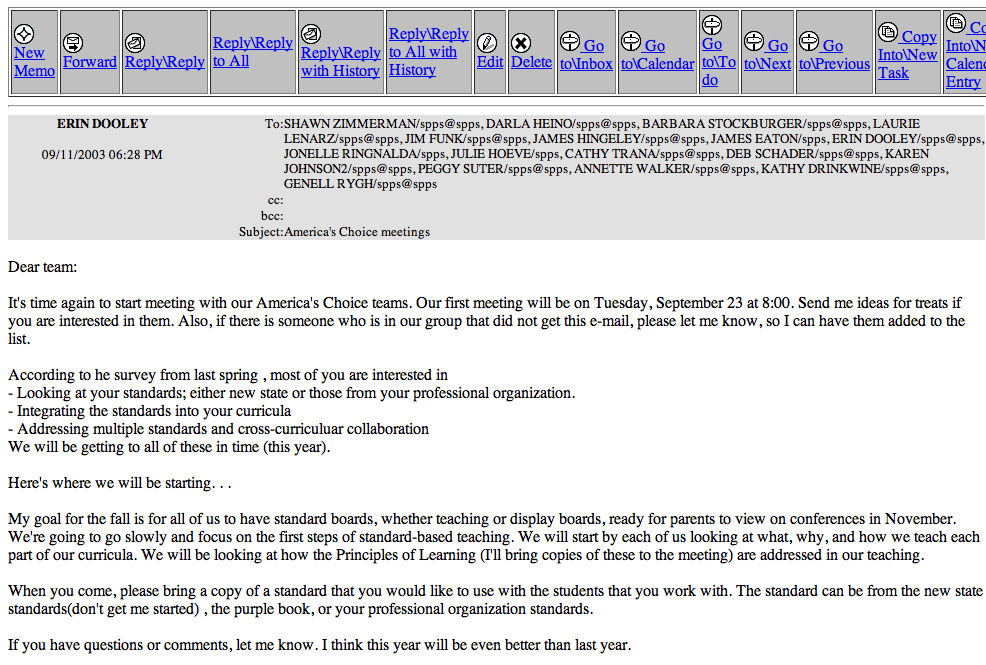
America's Choice PLC.png Size : 0.131 Kb Type : png |
|
|
Leadership Team Minutes 3-18-09-2.doc Size : 0.048 Kb Type : doc |