2. Information Collection
1. gather data and facts from a variety of sources about families, students, parents, staff members, administrators and community members;
2. seek knowledge about policies, rules, laws, precedents or practices;
3. manage data flow;
4. classify and organize information for use in decision making and monitoring information.
Data can come in many forms: AYP assessments, interim data, opinion polls, anecdotal reports for community members/parents/staff/learners. Each piece of data is important and needs to be looked at in its own way for specific purpose. Leaders need to be able to discern between data and information. Information is the sub-set of data that is relevant to the present situation (Ayres, 2008). Leaders need to stem the tide of data and utilize only that which will keep the school on the pathway to meeting the mission. Of course, a wise leader will also keep their “finger on the pulse” of trends and issues that are outside the realm of the mission – things that could sidetrack progress and/or cost the school political capital – but the focus needs to remain the focus.
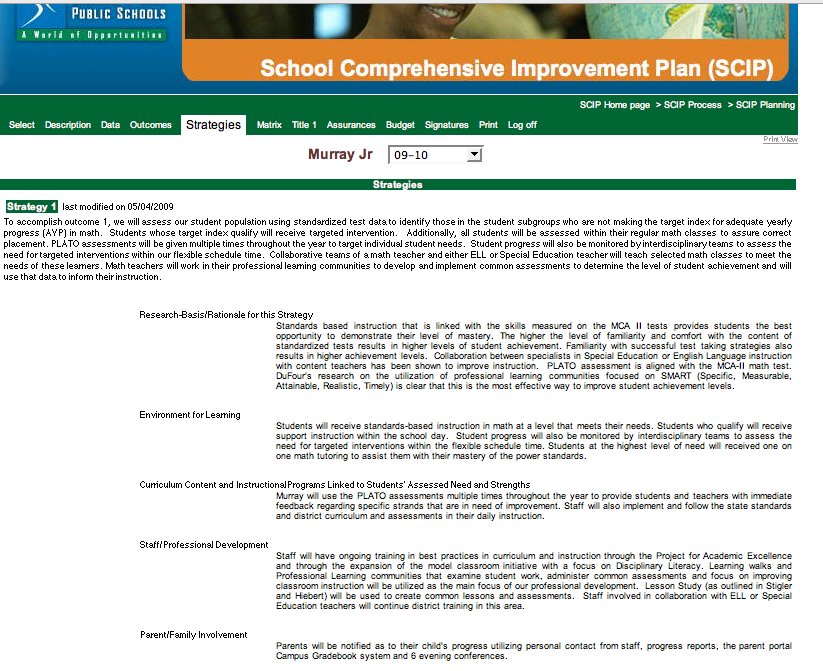
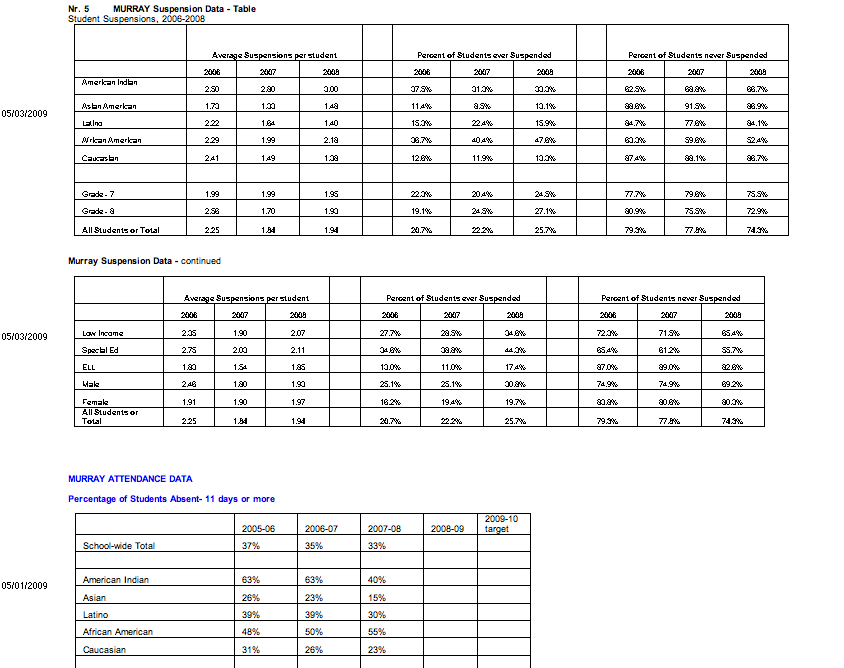
Over the past few years I have had the opportunity to use several different kinds of data and types of assessment data in leadership capacities. For my school’s improvement plan (SCIP) school year 2008-2009, we chose to incorporate data from our families and students with respect to safety and relationships within the building and between staff and students/families and information on suspension rates. The leadership team also examined behavior data to look for areas to target for improvement with staff development in the area of student discipline. I utilized data for the number of students suspended from our school as well as an understanding of the behavior program that the Leadership Team was looking into as a basis for the behavior goal for our SCIP this year. The goal was ultimately changed to reflect the district’s ultimate goal for junior high schools. We decided to drop the improvement on parent surveys as a goal for the next year, as our approval rating had remained in the mid-ninety percent positive range for several years and having fewer goals would increase the capacity of the school to monitor each one.
I have, over the years as part of writing SCIP goals, examined state summative data. And as a teacher, I have always used formative assessment, either formal or informal. However, while leading the science department’s Professional Learning Community (PLC) last year, I had the opportunity to look at data in what it turns out is another way. At the time, I was unaware that it was a separate class of assessment data – Interim Data. This is data from common assessments given across a number of classrooms to examine whether the essential benchmarks that were the goal of that time period (trimester, month) were actually being met. Data analysis can also inform instruction to identify staff members who seem to have a knack for teaching specific benchmarks, which is useful for PLCs and/or Lesson Study.
In the future, I plan to facilitate staff development that guides teachers in the use of the powerful tools of formative and interim assessment. Generally, as an administrator, I will need to rely on summative data, such as the MCA tests to see if my staff and programs are on track. I prefer to be more proactive and encourage the use of interim data to see where we are missing the mark as we go through the process. This way, systems can be put into place and safety nets created to give students targeted instruction, where needed to ultimately meet the learning goals. A word of caution for myself if no one else: avoid substituting any assessment success for summative assessment success. By that I mean the ultimate success is whether students have mastered the material to the extent that they can be tested on it after a year (or longer, in the case of the junior high science MCA). Having students pass a test within days of learning the material, or passing a less rigorous test, is no substitute for testing true mastery of the material for the long-term.
Ayers, Michael. Lecture, June 23 2008.
1. gather data and facts from a variety of sources about families, students, parents, staff members, administrators and community members;
2. seek knowledge about policies, rules, laws, precedents or practices;
3. manage data flow;
4. classify and organize information for use in decision making and monitoring information.
Data can come in many forms: AYP assessments, interim data, opinion polls, anecdotal reports for community members/parents/staff/learners. Each piece of data is important and needs to be looked at in its own way for specific purpose. Leaders need to be able to discern between data and information. Information is the sub-set of data that is relevant to the present situation (Ayres, 2008). Leaders need to stem the tide of data and utilize only that which will keep the school on the pathway to meeting the mission. Of course, a wise leader will also keep their “finger on the pulse” of trends and issues that are outside the realm of the mission – things that could sidetrack progress and/or cost the school political capital – but the focus needs to remain the focus.
Over the past few years I have had the opportunity to use several different kinds of data and types of assessment data in leadership capacities. For my school’s improvement plan (SCIP) school year 2008-2009, we chose to incorporate data from our families and students with respect to safety and relationships within the building and between staff and students/families and information on suspension rates. The leadership team also examined behavior data to look for areas to target for improvement with staff development in the area of student discipline. I utilized data for the number of students suspended from our school as well as an understanding of the behavior program that the Leadership Team was looking into as a basis for the behavior goal for our SCIP this year. The goal was ultimately changed to reflect the district’s ultimate goal for junior high schools. We decided to drop the improvement on parent surveys as a goal for the next year, as our approval rating had remained in the mid-ninety percent positive range for several years and having fewer goals would increase the capacity of the school to monitor each one.
I have, over the years as part of writing SCIP goals, examined state summative data. And as a teacher, I have always used formative assessment, either formal or informal. However, while leading the science department’s Professional Learning Community (PLC) last year, I had the opportunity to look at data in what it turns out is another way. At the time, I was unaware that it was a separate class of assessment data – Interim Data. This is data from common assessments given across a number of classrooms to examine whether the essential benchmarks that were the goal of that time period (trimester, month) were actually being met. Data analysis can also inform instruction to identify staff members who seem to have a knack for teaching specific benchmarks, which is useful for PLCs and/or Lesson Study.
In the future, I plan to facilitate staff development that guides teachers in the use of the powerful tools of formative and interim assessment. Generally, as an administrator, I will need to rely on summative data, such as the MCA tests to see if my staff and programs are on track. I prefer to be more proactive and encourage the use of interim data to see where we are missing the mark as we go through the process. This way, systems can be put into place and safety nets created to give students targeted instruction, where needed to ultimately meet the learning goals. A word of caution for myself if no one else: avoid substituting any assessment success for summative assessment success. By that I mean the ultimate success is whether students have mastered the material to the extent that they can be tested on it after a year (or longer, in the case of the junior high science MCA). Having students pass a test within days of learning the material, or passing a less rigorous test, is no substitute for testing true mastery of the material for the long-term.
Ayers, Michael. Lecture, June 23 2008.

|
SCIP Strategies.png Size : 0.168 Kb Type : png |
|
|
SCIP Data Page 3.png Size : 0.047 Kb Type : png |

|
Murray vs. State data.pdf Size : 0.011 Kb Type : pdf |

|
PDPLC student MCA survey.xls Size : 0.05 Kb Type : xls |