6. Implementation Skills
1. put programs into action;
2. facilitate the coordination and collaboration of tasks;
3. establish project checkpoints and monitor progress;
4. provide corrections when actual outcomes start to diverge from intended outcomes or when new conditions require adaptation;
5. support those persons responsible for carrying out projects and plans.
Once there is a mission for a building, the administrator needs to ensure that there are systems in place to meet the mission. Developing systems involves examining the school data, connecting with school staff and understanding the community that is the school itself. There then need to be priorities, in terms of where energy needs to be directed first. From that point, either the whole staff or a representative group needs to develop specific programs for scaffolding the school and leading toward the mission. It is imperative that these systems do not remain the domain of the administrator. Teacher leaders and/or teacher groups need to facilitate the actual implementation of the programs. Teacher leaders or groups should also monitor themselves for success as the process moves forward. It is important for the administrator to monitor the progress and keep in touch with both the progress and the process so that if the need arises to make changes, the administrator can facilitate the adjustments with the group.
The most exciting application for this competency for me in the past year is the development of an in-school intervention plan centered around a mini-period within the school day. The purpose of this period would be enrichment courses for some students, targeted interventions for other students, and to allow the opportunity for students taking band and language to fulfill their Physical Education and Health requirements. This half-hour chunk of time began to take shape in April as the Leadership Team continued to meet on the “issue” of students who didn’t have the chance to meet the PE and Health requirements. There were several incarnations of the period, and finally we suggested involving all students in this mini period (now called Pilot time) and utilize it for targeted interventions for students who do not meet the benchmark goals during the trimester in which they were taught, enrichment courses for students who are on target with their benchmarks but don’t need the PE/Health courses during this time. There would be time during two days per week for silent reading, PLC time for teachers, and advisory.
We then tackled the issue of matching students with targeted classes support and how they would rotate into and out of them. I suggested that the Pilot times rotate monthly, with September for advisory establishment and team building (silent reading and testing take place in advisories). This way, students will have 9-11 sessions per month from October through May to focus on specific learning targets and teachers will be able to focus on the essence of what the benchmark (or at most two) is all about. During the end-of-the-year Leadership Team meeting, we discussed methods to move PLC time into Pilot time. Our principal also informed us at this time that the district was implementing a ramp-up for college readiness, which would involve approximately one hour of instruction per month for all students in the school. At this point, one of my colleagues suggested that we combine the college readiness instruction with PLC time – students who are attending Pilot time with math teachers would have the college readiness content in the auditorium on two days per month (i.e. every other Monday). The auditorium classes – approximately 140 students – would be lead by counselors, administrators, and a staff member whose salary is paid for by a grant for this purpose. The math teachers would then be free to meet with their PLCs twice per month for 30 minutes. This system will take a lot of tweaking, and the leaders of each PLC will need to be very organized and structured in their leading of the groups, however, implementing this program will meet the following needs: Health/PE standards, targeted interventions, PLC meeting time, silent reading time, advisory, college readiness, and the flexibility that comes with these classes switching every month. It will be an uphill fight to get the kinks out, but I think it will be worth it in the long run.
What I take with me from this process is the following: 1- Stay flexible; sometimes trying a new idea enables you to solve more problems than you initially thought. 2- Be open to multiple points of view, as long as they are in support of the program rather than simply trying to find an easy way out. Having many voices with many ideas is always a good thing. 3- Sometimes, when things get added, they actually help to solve a problem. We learned this with the addition of the ramp-up to readiness college prep curriculum requirement that brought counselor time and an additional staff member, enabling us to take a large group to the auditorium for this instruction and freeing up one department per week to focus on their PLC. And 4 (this is one that I actually used to convince some staff members who were on the fence)- Even if an incoming system is perfect, it will be painful so we need to step away from the concept that if change is not pleasant it is the wrong direction. Anything worth doing is worth doing and there will be kinks that need to be worked out even in the best of plans.
1. put programs into action;
2. facilitate the coordination and collaboration of tasks;
3. establish project checkpoints and monitor progress;
4. provide corrections when actual outcomes start to diverge from intended outcomes or when new conditions require adaptation;
5. support those persons responsible for carrying out projects and plans.
Once there is a mission for a building, the administrator needs to ensure that there are systems in place to meet the mission. Developing systems involves examining the school data, connecting with school staff and understanding the community that is the school itself. There then need to be priorities, in terms of where energy needs to be directed first. From that point, either the whole staff or a representative group needs to develop specific programs for scaffolding the school and leading toward the mission. It is imperative that these systems do not remain the domain of the administrator. Teacher leaders and/or teacher groups need to facilitate the actual implementation of the programs. Teacher leaders or groups should also monitor themselves for success as the process moves forward. It is important for the administrator to monitor the progress and keep in touch with both the progress and the process so that if the need arises to make changes, the administrator can facilitate the adjustments with the group.
The most exciting application for this competency for me in the past year is the development of an in-school intervention plan centered around a mini-period within the school day. The purpose of this period would be enrichment courses for some students, targeted interventions for other students, and to allow the opportunity for students taking band and language to fulfill their Physical Education and Health requirements. This half-hour chunk of time began to take shape in April as the Leadership Team continued to meet on the “issue” of students who didn’t have the chance to meet the PE and Health requirements. There were several incarnations of the period, and finally we suggested involving all students in this mini period (now called Pilot time) and utilize it for targeted interventions for students who do not meet the benchmark goals during the trimester in which they were taught, enrichment courses for students who are on target with their benchmarks but don’t need the PE/Health courses during this time. There would be time during two days per week for silent reading, PLC time for teachers, and advisory.
We then tackled the issue of matching students with targeted classes support and how they would rotate into and out of them. I suggested that the Pilot times rotate monthly, with September for advisory establishment and team building (silent reading and testing take place in advisories). This way, students will have 9-11 sessions per month from October through May to focus on specific learning targets and teachers will be able to focus on the essence of what the benchmark (or at most two) is all about. During the end-of-the-year Leadership Team meeting, we discussed methods to move PLC time into Pilot time. Our principal also informed us at this time that the district was implementing a ramp-up for college readiness, which would involve approximately one hour of instruction per month for all students in the school. At this point, one of my colleagues suggested that we combine the college readiness instruction with PLC time – students who are attending Pilot time with math teachers would have the college readiness content in the auditorium on two days per month (i.e. every other Monday). The auditorium classes – approximately 140 students – would be lead by counselors, administrators, and a staff member whose salary is paid for by a grant for this purpose. The math teachers would then be free to meet with their PLCs twice per month for 30 minutes. This system will take a lot of tweaking, and the leaders of each PLC will need to be very organized and structured in their leading of the groups, however, implementing this program will meet the following needs: Health/PE standards, targeted interventions, PLC meeting time, silent reading time, advisory, college readiness, and the flexibility that comes with these classes switching every month. It will be an uphill fight to get the kinks out, but I think it will be worth it in the long run.
What I take with me from this process is the following: 1- Stay flexible; sometimes trying a new idea enables you to solve more problems than you initially thought. 2- Be open to multiple points of view, as long as they are in support of the program rather than simply trying to find an easy way out. Having many voices with many ideas is always a good thing. 3- Sometimes, when things get added, they actually help to solve a problem. We learned this with the addition of the ramp-up to readiness college prep curriculum requirement that brought counselor time and an additional staff member, enabling us to take a large group to the auditorium for this instruction and freeing up one department per week to focus on their PLC. And 4 (this is one that I actually used to convince some staff members who were on the fence)- Even if an incoming system is perfect, it will be painful so we need to step away from the concept that if change is not pleasant it is the wrong direction. Anything worth doing is worth doing and there will be kinks that need to be worked out even in the best of plans.

|
Sample PLC-PDP minutes.doc Size : 0.02 Kb Type : doc |
|
|
Pilot Time draft 6-11-09.doc Size : 0.068 Kb Type : doc |

|
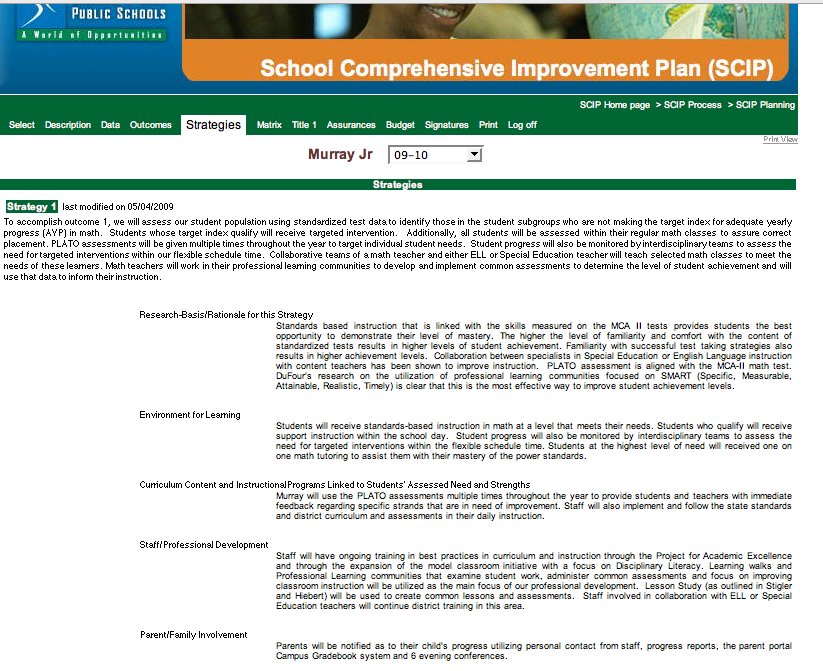
SCIP Strategies.png Size : 0.168 Kb Type : png |