13. Resource Allocation
1. procure, apportion, monitor, account for, and evaluate fiscal and human materials and time resources to reach outcomes that reflect the needs and goals of the school;
2. plan and develop the budget process with appropriate staff.
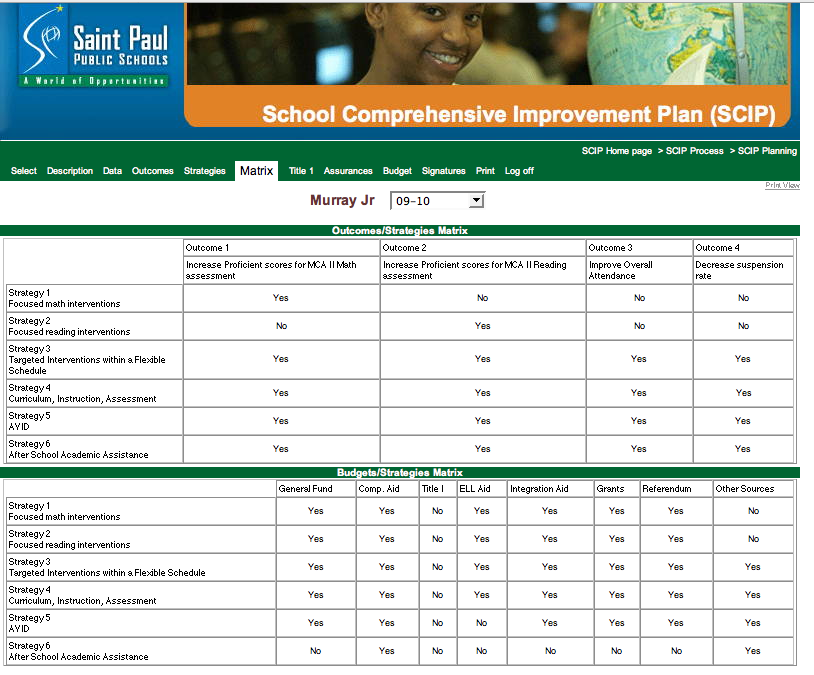
In these tight financial times, as with all times when it comes to publicly funded entities, it is important to be fiscally responsible. It is also important to match funds with a carefully planned school improvement plan (SCIP). When I first read this competency, I thought of it as merely budgeting for the staff and other needs within my school. As such, in large districts lake St. Paul, many staffing choices are made at the district level. Not necessarily the particular hires, but the number of staff members within each area – Special Education teachers, ELL teachers and aides in these areas, etc., which are set and funded by the district. Principals need to plan carefully to meet the projected staffing needs of the building, generally being conservative, for the upcoming year. There are generally no additional funds to augment staffing needs and changes in staff during a school year are very disruptive to the learning environment.
As I was reflecting on this competency during my field service hours, I began to see a bigger picture. While there is little budgeting “wiggle room” within buildings, these schools are part of a larger system with far more resources available to each school on a shared basis. I saw this first hand while dealing with a student who was ultimately moved from on classroom to another in April after a meeting the administrator and myself with representatives from the district’s Special Education and Equity offices. By pulling in informed others, the administrator was able to augment her staff with experts in various fields, such as those mentioned above. Also during the week, she used the district specialists in math, reading, targeted services, and data analysis to help her to create her improvement plan for the following year. At Murray, we are planning to utilize a district grant-funded person to assist us in planning for and implementing our new schedule and the addition of a district mandated ramp-up to readiness program for getting ready for college starting in junior high.
As I move into my own building, I will keep in mind the fact that the money I am investing in my staff and building is, for the most part, not my own. I need to be aware that spending decisions I make need to be logical, fiscally responsible, and in line with the school’s mission and SCIP. I will research uses for the various funding streams to find the best ways to spend each pool of money to make the most of it for the school and our mission. I will make full use of coaches and other experts available to me from the district, as well as tapping into community resources that are available. To do this last step will require a person who is responsible for carrying out this duty. I feel that the money would be well spent to have a part-time coordinator for community resources. Tapping into outside resources is key to maximizing the human potential within buildings with limited budgets.
1. procure, apportion, monitor, account for, and evaluate fiscal and human materials and time resources to reach outcomes that reflect the needs and goals of the school;
2. plan and develop the budget process with appropriate staff.
In these tight financial times, as with all times when it comes to publicly funded entities, it is important to be fiscally responsible. It is also important to match funds with a carefully planned school improvement plan (SCIP). When I first read this competency, I thought of it as merely budgeting for the staff and other needs within my school. As such, in large districts lake St. Paul, many staffing choices are made at the district level. Not necessarily the particular hires, but the number of staff members within each area – Special Education teachers, ELL teachers and aides in these areas, etc., which are set and funded by the district. Principals need to plan carefully to meet the projected staffing needs of the building, generally being conservative, for the upcoming year. There are generally no additional funds to augment staffing needs and changes in staff during a school year are very disruptive to the learning environment.
As I was reflecting on this competency during my field service hours, I began to see a bigger picture. While there is little budgeting “wiggle room” within buildings, these schools are part of a larger system with far more resources available to each school on a shared basis. I saw this first hand while dealing with a student who was ultimately moved from on classroom to another in April after a meeting the administrator and myself with representatives from the district’s Special Education and Equity offices. By pulling in informed others, the administrator was able to augment her staff with experts in various fields, such as those mentioned above. Also during the week, she used the district specialists in math, reading, targeted services, and data analysis to help her to create her improvement plan for the following year. At Murray, we are planning to utilize a district grant-funded person to assist us in planning for and implementing our new schedule and the addition of a district mandated ramp-up to readiness program for getting ready for college starting in junior high.
As I move into my own building, I will keep in mind the fact that the money I am investing in my staff and building is, for the most part, not my own. I need to be aware that spending decisions I make need to be logical, fiscally responsible, and in line with the school’s mission and SCIP. I will research uses for the various funding streams to find the best ways to spend each pool of money to make the most of it for the school and our mission. I will make full use of coaches and other experts available to me from the district, as well as tapping into community resources that are available. To do this last step will require a person who is responsible for carrying out this duty. I feel that the money would be well spent to have a part-time coordinator for community resources. Tapping into outside resources is key to maximizing the human potential within buildings with limited budgets.

|
Excerpts from 4th Grade Student Observation.doc Size : 0.028 Kb Type : doc |

|
SCIP Budget Matirx.png Size : 0.188 Kb Type : png |