10. Student Guidance and Development
1. understand and accommodate student growth and development;
2. provide for student guidance and auxiliary services;
3. utilize community organizations in responding to family needs;
4. enlist the participation of people to design and conduct programs for connecting school programs with plans for adult life;
5. plan for a comprehensive program of student activities.
The ultimate goal of education, with or without the No Child Left Behind legislation, is to educate every child. An educational leader needs to oversee integrated programs to connect students to learning and prepare them for the next steps of education in preparation to becoming productive adults. These can include a well-planned program within the school day to provide a high-rigor standards-based curriculum, extended day programs for support of learners needing more time to meet the standards, extended year programs for additional focus on targeted benchmarks, test prep, and/or credit recovery. The school should also implement community services to meet academic or other needs. These can include tutoring services, but also social services to meet specific needs of individual students to help the students be more able to focus on the academic tasks at hand.
I have been very impressed at how my current school is able to coordinate community services, including a tutoring program that is integrated within our school day for selected students, volunteers for large-scale school events, and coordinating the recruiting of college students to work within our classes. We budget for a half-time coordinator who oversees all of these programs in addition to a few other systems. It is money well spent. We are the only secondary school with a paid volunteer coordinator, and I have never been in a building with more organized volunteer services available to the staff.
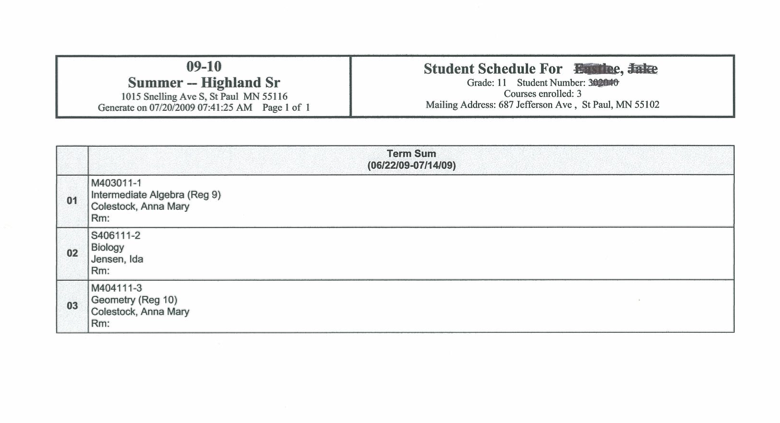
This past summer, I had more direct experience with student guidance, when many of our summer students were not enrolled in courses that meet all of their needs. Students were initially registered for specific courses that they needed based on test-prep needs and credits missing from the previous year. During the first couple of days I, along with the school-year ALC coordinator, met with students to more closely examine their schedules to meet specific needs including finding missing (required) classes from earlier in their school career (i.e. one senior who was missing a freshman English class and needed to make it up to graduate). Additionally, students needing transportation were required to be registered for a full course load, so I added classes to augment needed classes to allow for transportation needs.
In society today, there are students who don’t fit the “traditional” model of a learner – able to be at school every day ready to learn and relatively willing to do what is necessary to move on to the next level. In reality, there have always been students who didn’t fit that model; those students dropped out before graduating high school. Now the goal is to get all students through the standards needed to graduate. This requires a re-thinking of how we approach education. As a leader I will remain mindful that not all learners arrive at school at the same level of readiness, in fact, not all of them arrive at school. Supporting the needs of all learners will be part of both my School Improvement Plan (SCIP) and budget. Programming beyond a solid classroom experience is needed to get all students prepared for the future. Having a system of implementing support services is required; I plan to employ a support service coordinator to oversee the implementation of these programs, a choice that may be seen as controversial in these times of tight budgets, but I feel that the benefits reaped make it money well spent.
1. understand and accommodate student growth and development;
2. provide for student guidance and auxiliary services;
3. utilize community organizations in responding to family needs;
4. enlist the participation of people to design and conduct programs for connecting school programs with plans for adult life;
5. plan for a comprehensive program of student activities.
The ultimate goal of education, with or without the No Child Left Behind legislation, is to educate every child. An educational leader needs to oversee integrated programs to connect students to learning and prepare them for the next steps of education in preparation to becoming productive adults. These can include a well-planned program within the school day to provide a high-rigor standards-based curriculum, extended day programs for support of learners needing more time to meet the standards, extended year programs for additional focus on targeted benchmarks, test prep, and/or credit recovery. The school should also implement community services to meet academic or other needs. These can include tutoring services, but also social services to meet specific needs of individual students to help the students be more able to focus on the academic tasks at hand.
I have been very impressed at how my current school is able to coordinate community services, including a tutoring program that is integrated within our school day for selected students, volunteers for large-scale school events, and coordinating the recruiting of college students to work within our classes. We budget for a half-time coordinator who oversees all of these programs in addition to a few other systems. It is money well spent. We are the only secondary school with a paid volunteer coordinator, and I have never been in a building with more organized volunteer services available to the staff.
This past summer, I had more direct experience with student guidance, when many of our summer students were not enrolled in courses that meet all of their needs. Students were initially registered for specific courses that they needed based on test-prep needs and credits missing from the previous year. During the first couple of days I, along with the school-year ALC coordinator, met with students to more closely examine their schedules to meet specific needs including finding missing (required) classes from earlier in their school career (i.e. one senior who was missing a freshman English class and needed to make it up to graduate). Additionally, students needing transportation were required to be registered for a full course load, so I added classes to augment needed classes to allow for transportation needs.
In society today, there are students who don’t fit the “traditional” model of a learner – able to be at school every day ready to learn and relatively willing to do what is necessary to move on to the next level. In reality, there have always been students who didn’t fit that model; those students dropped out before graduating high school. Now the goal is to get all students through the standards needed to graduate. This requires a re-thinking of how we approach education. As a leader I will remain mindful that not all learners arrive at school at the same level of readiness, in fact, not all of them arrive at school. Supporting the needs of all learners will be part of both my School Improvement Plan (SCIP) and budget. Programming beyond a solid classroom experience is needed to get all students prepared for the future. Having a system of implementing support services is required; I plan to employ a support service coordinator to oversee the implementation of these programs, a choice that may be seen as controversial in these times of tight budgets, but I feel that the benefits reaped make it money well spent.

|
Pilot time one-month matirx.doc Size : 0.04 Kb Type : doc |